
Will Cuckooing Be Made Illegal? And Other ASB News…
ASB In The News
Cuckooing To Be Made A Criminal Offence?

The Times, The Telegraph, and The BBC have reported on the growing calls to criminalise ‘cuckooing,’ a term referring to the illegal practice where criminals commandeer vulnerable individuals’ homes for illicit activities such as drug dealing or sex work. Former Tory party leader Sir Iain Duncan Smith is advocating for the criminalisation of cuckooing, emphasising the urgent need for action to protect victims. Speaking at a conference in Leeds, Sir Iain highlighted that victims of cuckooing, including those with addiction, financial struggles, the elderly, and individuals with disabilities, have had their safe spaces violated. Perpetrators often exploit county lines drug networks to carry out cuckooing and evade law enforcement.
Despite governmental reluctance to amend legislation, Sir Iain and 48 other MPs have backed plans to make cuckooing a criminal offence, potentially through amendments to the Criminal Justice Bill. While official statistics on cuckooing remain scarce due to its not being a specific criminal offence, recent crackdowns on county lines have shed light on its prevalence. Dr. Laura Bainbridge, a criminal justice lecturer and founder of the Cuckooing Research & Prevention Network, who interviewed partner Darren Burton as part of her research, emphasised the predatory nature of cuckooing and its detrimental effects on victims and communities. Though the Home Office acknowledges cuckooing as abhorrent, it maintains that existing legal measures can address it.
Read the Telegraph article here (there is a paywall to this article. If you would like a free perspective the BBC have also covered the topic without reference to the MPs backing earlier in the year)
Darren’s Thoughts: Criminalising cuckooing would be a crucial step towards protecting vulnerable individuals and communities from exploitation and harm. By recognising the predatory nature of this practice and implementing legal measures to address it, we can send a clear message that such behaviour will not be tolerated. However, it’s important to ensure that any legislative changes are accompanied by robust support services for victims, including access to safe housing and specialised care. Additionally, law enforcement agencies must be adequately resourced to effectively investigate and prosecute cases of cuckooing, ultimately deterring perpetrators and safeguarding vulnerable individuals, as well as supporting Landlords and Housing Associations with investigating and prosecuting offenders.
It is also important to recognise the key role that the existing ASB Tools and Powers can play as part of an effective and co-ordinated partnership approach. The proposed expansion of Closure Order powers for Housing Associations is therefore of particular interest. This will, however; require clear and consistent information sharing protocols and the ability for ASB practitioners to quickly escalate concerns when suspected OCG involvement is identified.
Greater flexibility is also needed around sustainable, victim-led rehousing options to help achieve successful outcomes in the longer term.
Join Consilium Training For The Waste Crime Conference! Exclusive Discount Available…
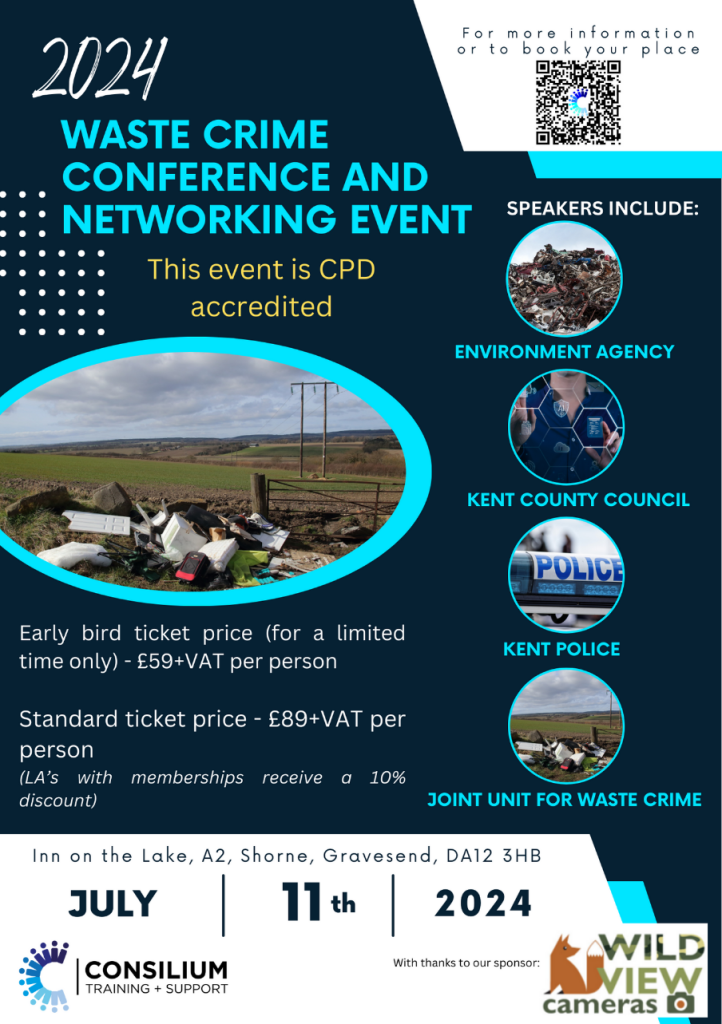
Our trusted partners Consilium Training are hosting an insightful exploration into the world of waste crime enforcement at their upcoming conference. Tailored for police, Environment Agency Officials, and Local Authority Investigators and Managers, this event delves into the complexities of tackling waste-related offences.
Featuring esteemed speakers from key entities such as the Environment Agency, Kent Police, Joint Unit for Waste Crime, and Kent County Council, this conference promises a diverse range of perspectives and expertise. Topics of discussion include updates on scrap metal enforcement and collaborative efforts, strategies for combating organised crime within the waste sector, the evolving threats and opportunities posed by lithium-ion batteries, leveraging intelligence to combat waste crime effectively, and the exploration of waste as a potential new County line.
Don’t miss this opportunity to enhance your knowledge and network with fellow professionals dedicated to combating waste crime. Use code ASB5 for an exclusive discount through Green & Burton ASB Associates – this applies to the early bird offer too so be quick to secure your space…
Highlighting Neurodiversity In The Sector
Neurodiversity Celebration Week has just come to a conclusion across the UK and there have been a number of publications and awareness events taking place to highlight the importance of understanding and supporting neurodivergent people in our society. Neurodivergent individuals, such as those with ADHD, autism, dyspraxia, dyscalculia, dyslexia, and developmental language disorder, have unique strengths and talents that need to be recognised, and this is something that we are keen to emphasise here at Green & Burton ASB Associates.
Our own article published this February highlighted the potential mental health conditions which can cause ASB in children, which coincides really well with a recent article published by Professor Amanda Kirby on the overrepresentation of neurodivergent children in the justice system. In the article she highlights that at least one in three youths in the justice system are classed as being neurodivergent, compared to a lower proportion in the general population. This overrepresentation reflects systemic failures, including barriers to identification, delays in assessments, lack of appropriate support, and societal stigma. You can read the full article here.
Neurodiversity is becoming so much more prevalent in our communities, and our workplaces, and ensuring that we raise awareness and think strategically about how we evolve our approach is important on a number of levels.
Janine’s Thoughts: The subject of neurodivergence and inclusivity is something that I am personally passionate about, and a topic I think that should extend beyond discussing children and youth, but how neurodivergence affects us overall. I am looking towards our next free webinar, and I need your help. Recently I have been thinking a lot about how inclusive our ASB processes truly are… We talk about being fair, considering everyone’s needs, and making decisions based on each situation, but I still think there’s more we could do.
I’m sure we have all noticed that more and more people with different ways of thinking, or neurodiversity, are coming into contact with our ASB processes. Some of the steps we usually take might be tough for them because their brains work differently from what’s considered “normal.” I want to dive into these challenges and see what small changes we can make to be truly inclusive. I know neurodiversity shows up in lots of different ways, so I want to hear from ASB professionals who identify as neurodiverse. Your input can help us understand how standard ASB processes might affect someone with diverse thinking, and what we can do differently. This isn’t about putting anyone on the spot or making you speak in front of a big crowd. It’s just a confidential chat to help us make positive changes in how we handle ASB cases. So, if you’re in ASB work and identify as neurodiverse, I’d love to hear from you. Drop me an email at janine@janinegreenasb.co.uk or reach out via LinkedIn.
Research Request

New Study: Supporting victim survivors of gambling-related domestic abuse – a focus on women in social housing.
A research project, funded by the Gambling Commission, is underway until 2025, focusing on supporting victim survivors of gambling-related domestic abuse, particularly women in social housing and local authority-supported accommodation in England. The project involves an expert advisory panel and research partners from Durham University, Sheffield Hallam University, Cranfield University, Betknowmore UK, and Addressing Domestic Abuse.
The research team is seeking input from housing providers regarding their current approaches to addressing gambling harms and domestic abuse. They are looking for practitioners to participate in an anonymous survey, and to pursue opportunities for in-depth interviews with victim survivors and stakeholders. There are focus groups planned in Durham/Newcastle, Liverpool, London, and Birmingham.
The project aims to produce a free toolkit for social housing and other sectors based on research findings, alongside a detailed research report with policy proposals. More information is available on the project website or via email – please check it out and contribute where it is appropriate.
Website: https://dagamblingharmsproject.webspace.durham.ac.uk
ASB Support For You
Limited Spaces Remaining for April Events
Discover new insights and practical strategies at our live training events this April, delivered by our expert team of associates live online via Teams. With limited spaces available we would urge you to secure your spaces to avoid disappointment. April’s line up of training has two immersive sessions:
18.04 – Drafting A Notice Of Seeking Possession Order – LIMITED SPACES REMAINING
24.04 – Harm Centred Approaches
We also have two Masterclasses that will give you hands on support in an intimate environment – a perfect solution for your organisation if you need expert eyes on your business without the cost of bespoke consultancy services, or if you want to benchmark with your peers. Our next scheduled Masterclasses are:
23.04 – Customer Satisfaction with Darren Burton
30.04 – Chairing An ASB Case Review with Katy Anderson
We hope to see you at one of our events very soon, and as always welcome any feedback on how we can make this weekly update as useful as possible for you. Have a great week!
Janine & Darren