
Mental Health Awareness Week Focus Edition
In This Edition:
- ASB In The News
- Updated MASH Guidelines
- Mental Health Awareness Week
- Victim Risk Assessments & Mental Health
- This Weeks Top Tip
- Janine & Darren’s Weekly Round Up
ASB In The News
Here’s your weekly round-up of cases which have made the national and local media. Is there a case you’ve worked on that you would like us to feature? Get in touch to be part of our ASB case study programme!
- Newcastle – New restrictions aim to curb anti-social behaviour in Newcastle tower blocks
Read Here - Wrexham – Police launch crackdown on antisocial behaviour in Acrefair
Read Here - West Midlands – Arrests and bikes seized during off-road bike operation targeting anti-social behaviour in Walsall
Read Here - Somerset – Churchyard closes due to anti-social behaviour
Read Here - Cleveland – Anti-social house ‘making life a misery’ shut down
Read Here - Yorkshire – North Yorkshire Police shut down Harrogate property following persistent anti-social behaviour
Read Here - Cambridge – Cambridge home closed for three months following anti-social behaviour
Read Here - Walsall – Walsall brothel disrupted and 20 arrests amid organised crime and anti-social behaviour crackdown
Read Here
Updated Mash Guidelines
The Multi-Agency Safeguarding Hub (MASH) Guiding Principles have been updated and republished this month, setting out expectations for effective multi-agency safeguarding arrangements.
For ASB professionals, this document is a useful reference point. ASB casework frequently intersects with safeguarding concerns, particularly where children, vulnerable adults, or complex needs are involved. The principles provide a clear framework for roles, responsibilities, information sharing, and risk-based decision-making – all essential components of joined-up ASB case management.
Download the guide to read in full and consider how your current working arrangements align with the new principles.
Mental Health Awareness Week 2025: The Role of Community in Supporting Mental Wellbeing
This year’s Mental Health Awareness Week centres on the theme of community – a timely reminder of the role connection, belonging, and shared responsibility play in supporting wellbeing.
For ASB professionals, community is at the heart of everything we do. Whether it’s helping someone feel safe in their home, preventing harm through early intervention, or resolving issues that threaten neighbourhood cohesion, we see first-hand the impact that anti-social behaviour can have on mental health, both for those experiencing harm and those causing it.
This week is an opportunity to reflect on how we can work together to make services more inclusive, ensure victims are heard and supported, and keep mental health considerations front and centre in how we assess, manage, and resolve ASB cases.
Supporting Mental Health in ASB Casework: Training Opportunity for Teams
As we mark Mental Health Awareness Week, it’s a timely reminder of the importance of understanding and empathy when working within communities — especially when anti-social behaviour and mental health intersect.
One of the most complex challenges ASB practitioners face is managing cases where the person responsible for the behaviour has poor mental health. Balancing support, risk, enforcement and legal responsibilities is not easy — particularly without formal training in mental health law or the Equality Act.
To support caseworkers with this, we offer ASB, Mental Health and the Equality Act — a practical training session that demystifies the legal framework and provides a clear, structured approach for managing these sensitive and often high-risk cases.
Delivered as a three-hour live course for teams, it covers:
- How casework changes when poor mental health is a factor
- The legal position around enforcement and mental health
- Equality Act challenges and how to manage them
- Proportionality, decision-making and documentation
- Working with partners including health and the voluntary sector
If you’re looking to equip your team with the tools and confidence to handle these cases safely and fairly, get in touch to organise a session.
Mental Health Awareness Week: Why Victim Risk Assessment Matters in ASB Casework
Continuing our focus on Mental Health Awareness Week 2025, we’re spotlighting the importance of recognising how anti-social behaviour can affect victims’ mental wellbeing – and how the way we respond can either support or further harm those impacted.
In a new article, associate Katy Anderson explores the critical role of victim risk assessment in ASB case management. Drawing on practical examples and key principles, she shares how timely, proportionate, and sensitive interventions can protect mental health, build trust, and ultimately lead to better outcomes for everyone involved.
Whether you’re reviewing your current approach or just starting to embed victim-centred practice, this is an essential read.
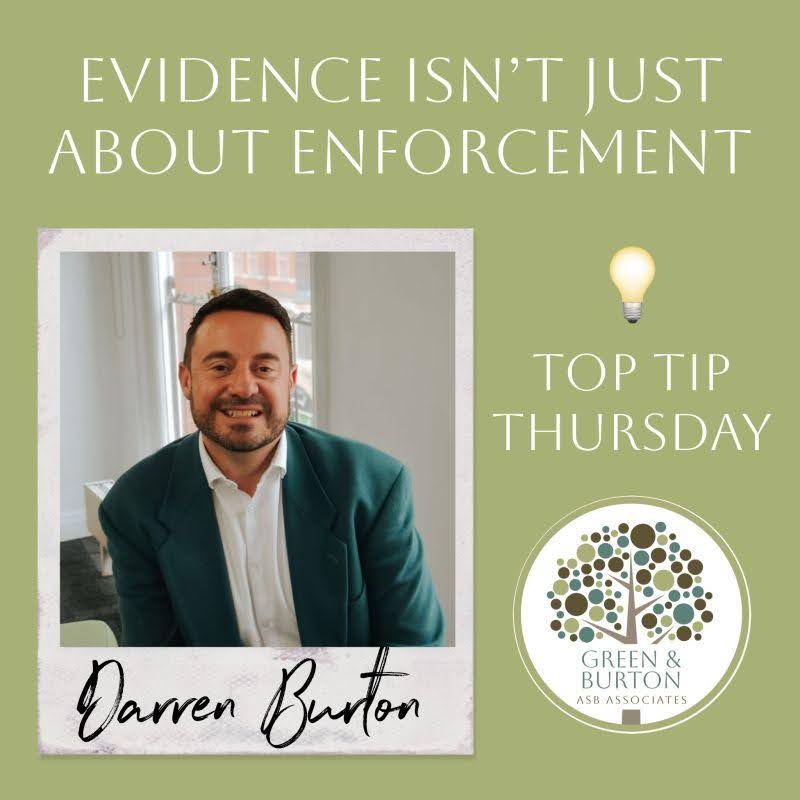
This Weeks Top Tip - Evidence Isn’t Just About Enforcement
This week’s advice comes from partner Darren Burton, who offers a valuable reminder about the importance of broadening our understanding of what counts as evidence – especially in early case management decisions.
Here’s Darren’s tip in full:
“Evidence isn’t just about enforcement.
We are coming across an increasing number of ASB cases that are closed at very early stage due to a “lack of evidence”. This is often due to the perception that enforcement action, in particular possession proceedings or an injunction, is the only available option.
Whilst it’s undoubtedly important to manage expectations from the outset, this can set the tone for the relationship and any further interaction with the victim or complainant. Customers can feel that they are not being listened to and instantly dismissed by the respective organisation so it’s worth being mindful that these experiences can come out in the wash as part of a Housing Ombudsman investigation if the issues continue and become escalated. In many cases, the incidents themselves are secondary to the way that the person feels that they have been treated.
Evidence doesn’t just have to relate to legal thresholds, it can focus upon displayed behaviours, a person’s ability to sustain a tenancy / make life choices, health & wellbeing, social networks and much more.
Cover all bases, have a think about what’s out there in terms of partner agency support and if you’ve got an idea for a potential solution then give it a try! So long as there is a suitable rationale behind your thought process (even if it’s just a hunch) and it’s documented as part of a robust audit trail it’s worth considering – You don’t want to reflect upon missed opportunities at a later stage and wonder “what if?” when things have become messy and there is no positive outcome in sight.
Somethings, the smallest, seemingly mundane intervention can make all the difference so why not give it a go!”
A thought-provoking contribution from Darren, and one that reminds us small, thoughtful actions can often have the biggest impact.
Janine & Darren’s Weekly Round Up
With Mental Health Awareness Week underway, it’s been a timely moment to reflect on the role ASB professionals play in supporting wellbeing – both for those harmed by ASB and those managing complex, often difficult, cases on the frontline.
This week’s updates, from new safeguarding principles to Darren’s top tip on evidence, have all underlined how small, considered actions can make a big difference. Staying grounded in empathy, clear communication, and joined-up working continues to be vital.
If you haven’t yet secured your subscriber-only Super Early Bird tickets for the #ASB11 Conference then now is the time. Over 15% of tickets have already been taken, so it’s a great moment to get ahead and plan for a day full of practical insight, learning, and sector connection. You can order yours here.
Have a great week!
Janine & Darren